

Emergency Locksmith Solutions for Denver Companies
Emergency Locksmith Solutions for Denver Companies
As a Denver business owner, your front door is your primary defense. According to material science, extreme temperature swings cause thermal expansion and contraction, misaligning hardware so standard locks fail to latch. Finding a commercial locksmith Denver businesses trust mitigates this risk.
Industry data reveals residential hardware cannot survive high-traffic storefronts. To prevent failure, facilities require ANSI/BHMA grading—a standardized system where Grade 1 signifies heavy-duty commercial durability, easily outlasting Grade 3 residential locks. Every professional Denver Colorado locksmith recommends this foundational upgrade.
Legal compliance strictly dictates these choices. Facilities must follow Life Safety Codes, requiring a “single motion” exit during emergencies with no twisting or fumbling. A reliable security door locksmith Denver managers respect ensures exits meet fire laws, protecting both lives and liability.
Stop Replacing Entire Locks: How Rekeying Saves 60% on Security Costs During Turnover
When a manager departs your LoDo retail shop, your first instinct might be buying entirely new door hardware. Yet, rekeying commercial locks after employee turnover remains a vastly smarter strategy for protecting your operational budget.
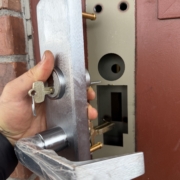
Think of this process like changing your Netflix password—you keep the expensive television but update the access code. Instead of replacing the heavy metal exterior, professionals rekey Denver properties by simply swapping out the lock’s tiny internal pins. Old keys become instantly useless while your physical door hardware stays perfectly intact.
Business owners frequently ask how much it costs to rekey a business compared to a full hardware replacement. Because you only pay for labor and microscopic brass pins, you maintain your storefront’s polished aesthetic while slashing security expenses by up to sixty percent.
Altering these internal mechanisms without discarding the durable lock body opens up advanced organizational possibilities. This exact pin-shifting foundation prepares you for building a permissions ladder, which simplifies management for multi-suite offices.
Building a Permissions Ladder: How Master Key Systems Simplify Management for Multi-Suite Offices
Managing a Denver Tech Center office suite shouldn’t require a heavy, janitor-style keyring. Proper master key system installation for businesses transforms that chaotic jumble into a streamlined permissions ladder. This limits employee movement strictly to required areas without adding expensive electronic hardware.
Think of this key hierarchy as a physical organizational chart. A standard three-tier setup includes:
- Grand Master Key: Held by owners, opening every single door across the entire facility.
- Master Key: Carried by managers, providing access to specific departmental zones or shared maintenance rooms.
- Change Key: Given to daily staff, unlocking only their individual office and the main entrance.
Restricting access drastically lowers your liability. If an employee misplaces their change key, you only rekey a single door, mitigating the severe financial risk of a lost grand master key. Utilizing mobile locksmith services for Denver property managers ensures seamless blueprint design and total administrative ease.
While mechanical hierarchies provide excellent baseline control, fast-paced environments sometimes demand digital flexibility for high-traffic entry points.
Keypads vs. Mechanical Locks: Identifying the Right Access Control for High-Traffic RiNo Breweries
Managing a bustling RiNo brewery requires entry solutions that adapt instantly to high staff turnover. Comparing electronic keypad locks vs mechanical locks for business ultimately comes down to flexibility versus physical simplicity, as standard hardware is durable but lacks real-time tracking.
Upgrading to cloud-based access control systems for Denver office buildings solves this operational visibility problem. These digital setups generate a continuous audit trail, providing managers with a detailed log of exactly whose PIN or fob unlocked a specific door and at what time.
If infrastructure dictates keeping traditional keys, owners often ask: what is a restricted keyway system? This highly secure mechanical upgrade utilizes patented lock cylinders that require specialized, factory-controlled key blanks, physically preventing departing employees from making unauthorized copies at a local hardware store.
Bridging both worlds involves installing an electric strike—a motorized plate built into the door frame that allows staff to remotely buzz in vendors without replacing the primary door handle. These strikes can seamlessly integrate with biometric entry systems for restricted areas, eliminating the risk of lost keys entirely in sensitive zones.
Whether your entrances rely on smart technology or traditional brass, commercial hardware must always legally guarantee safe, immediate evacuation, preventing the hidden liability of code violations.
The Hidden Liability of ‘One-Motion’ Exits: Mastering Panic Bar Installation and ADA Compliance
While heavy-duty locks secure your LoDo retail shop at night, fire codes dictate how easily people escape emergencies. Commercial doors follow life safety laws requiring a “single motion” to exit. Proper panic bar installation for fire safety compliance ensures pushing a horizontal bar instantly unlatches the door, protecting you from massive liability.
Everyday accessibility brings another layer of liability via ADA compliant commercial door hardware regulations. The legal standard here is the “One-Hand” rule: handles must operate without requiring tight grasping, pinching, or wrist twisting.
Behind the scenes, your entrances rely on hydraulic arms—door closers—to shut smoothly. Repairing commercial storefront door closers is critical if you notice oil leaking or doors slamming, as these physical failures invite heavy inspection fines.
Verify these elements to stay compliant:
- Do exits require only a single push?
- Can levers be operated without twisting?
- Are hydraulic closers free of oily leaks?
- Does the door latch itself completely?
Your 48-Hour Security Blueprint: Partnering with a Licensed Denver Professional for Regular Audits
Securing your business requires moving beyond basic hardware store fixes. Integrating high-security lock brands for commercial properties transforms your entrances into compliant, formidable defenses rather than DIY liabilities.
To experience the benefits of regular commercial security audits, establish a seasonal maintenance schedule to prevent extreme Denver weather from causing emergency lockouts. Always verify your commercial locksmith Denver partner is licensed, bonded, and insured—a non-negotiable standard for protecting your assets.
Improving physical security and office access demands proactive oversight. Within the next 48 hours, perform a simple security self-check on your doors and existing keys, then schedule a professional security audit to eliminate vulnerabilities completely.







Leave a Reply
Want to join the discussion?Feel free to contribute!